How to spot a bad bow-tie in an oval before you buy
A bow-tie is a darker band across the middle of an oval diamond: two dark wedges that meet in the centre. Almost every oval has one. GIA does not grade cut on ovals, and IGI's guidelines for an Excellent oval require that the bow-tie is not significant without putting a number on it, so you judge it yourself. In this model, the same oval shows a faint bow-tie at a 46.5% pavilion depth and a clear one at 42%, and both depths are inside IGI's Excellent range.
Written by Carat Hunter, an independent diamond price comparison site that does not sell diamonds. Last checked against its sources on .
What does a good oval look like?
This oval is modelled with proportions inside the ranges in this guide, with its pavilion at the deep end of IGI's range, 46.5%. Turn it: the centre stays bright, and the small dark areas move and break up rather than sitting still. A small, moving bow-tie is normal; almost every oval has one.
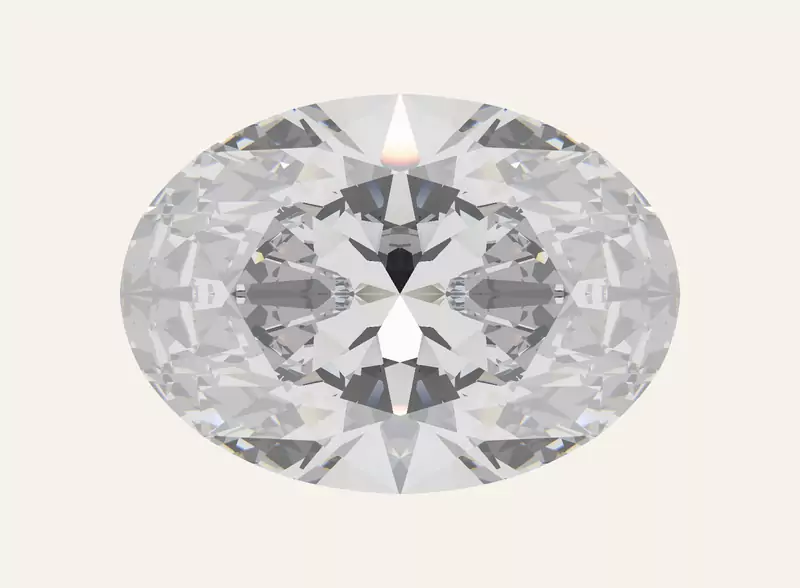 Drag to turn
This model's figures
- Length to width1.40Good: Inside IGI's Excellent range, 1.35 to 1.50
- Table58%
- Depth64.1%
- Pavilion depth46.5%Good: Inside IGI's Excellent range, 41% to 46.5%
- Girdlemedium
- Culetpointed
Good and Watch mark whether a figure is inside or outside a range GIA or IGI publishes; where no range applies, the note describes the model only.
What causes a bow-tie in an oval?
An oval is stretched from a round brilliant, and its facets do not return light evenly all around. Near the middle, some of them show you a reflection of your own head and shoulders, which blocks the light. That dark pattern is the bow-tie. GIA's researchers add that the choice of facet arrangement and proportions can make a bow-tie stronger or weaker.
Pears and marquises show it for the same reason, as do other elongated shapes. Rounds do not show a bow-tie, because they are not elongated and their facet pattern repeats evenly round the stone.
GIA describes a bow-tie as light from high angles, obscured by the viewer and channeled into the centre; our guide to reading an ASET image shows this page's clear oval in ASET light, where in this model the band shows blue.
A faint and a clear bow-tie, side by side
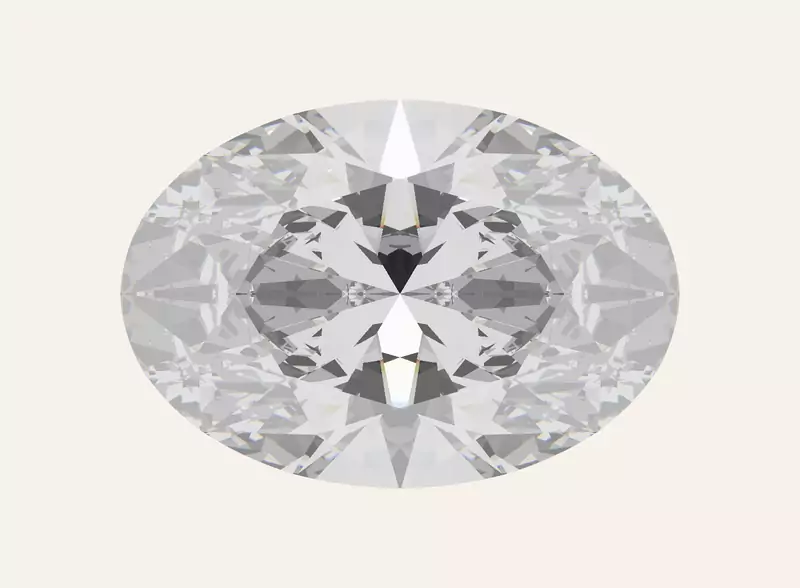
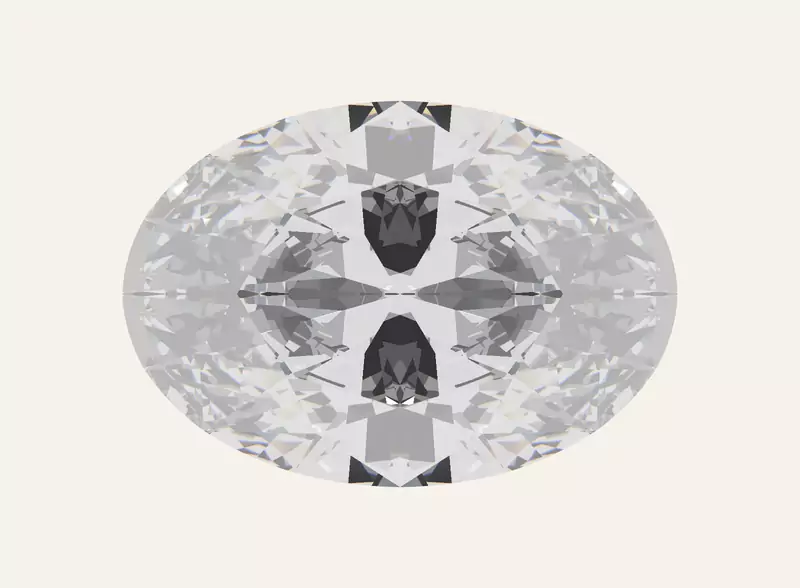
One oval of about 1.8 carats in this model, modelled twice. Only the pavilion depth changes, and both depths are inside IGI's range for an Excellent oval, 41% to 46.5%. In this model the shallower of the two leaves the darker band. IGI's Excellent also requires that the bow-tie is not significant, so proportions inside the ranges are not enough on their own. That is why the video beats the numbers.
 Drag to turn
 Drag to turn
What differs, in these models
Faint bow-tie
- Pavilion depth46.5%Good: Pavilion depth inside IGI's range; a faint bow-tie in this model
- Depth64.1%
Clear bow-tie
- Pavilion depth42%Watch: Pavilion depth inside IGI's range, but a clear bow-tie in this model; IGI also requires the bow-tie not be significant
- Depth59.6%
Good and Watch mark whether a figure is inside or outside a range GIA or IGI publishes; where no range applies, the note describes the model only.
Drag either stone; both turn together.
Modelled illustrations from one stone's measurements, not listings.
Why does a bow-tie look different in every photo?
The dark part is mostly you. As the stone tilts, different facets reflect your head, so the dark areas move. That is why a bow-tie can look bad in one photo and fine in the next. GIA's 2024 study of ovals, pears and marquises describes the same: some bow-ties stay dark as the stone moves, and others brighten. Judge it from a video or in person, never from a single still.
Drag to turnModelled illustrations from one stone's measurements, not listings.
Is a bow-tie bad?
Not always. In GIA's 2024 study, observers varied on how much a bow-tie mattered: some expect one in these shapes, and others prefer a small one or none at all. In the study's words, "Most trade observers disparaged prominent bow tie patterns," and its conclusions call large, dark, persistent bow-ties a negative factor.
Do longer ovals show a stronger bow-tie?
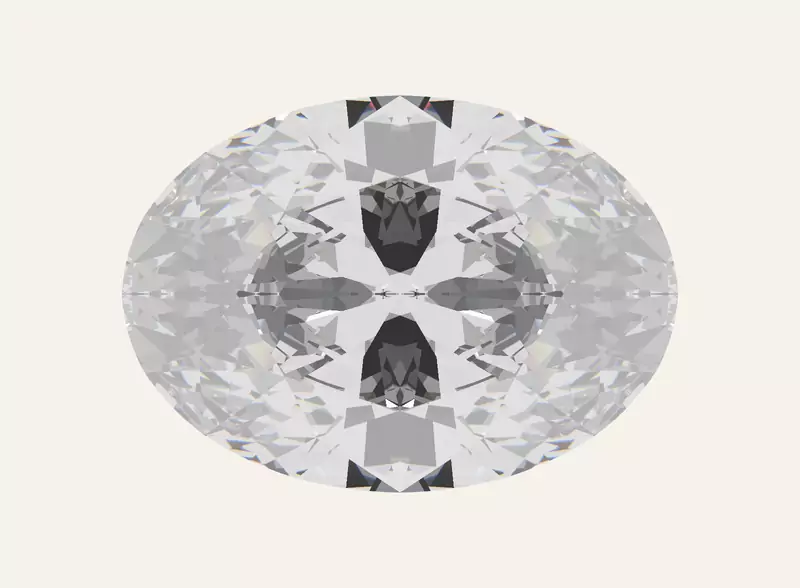
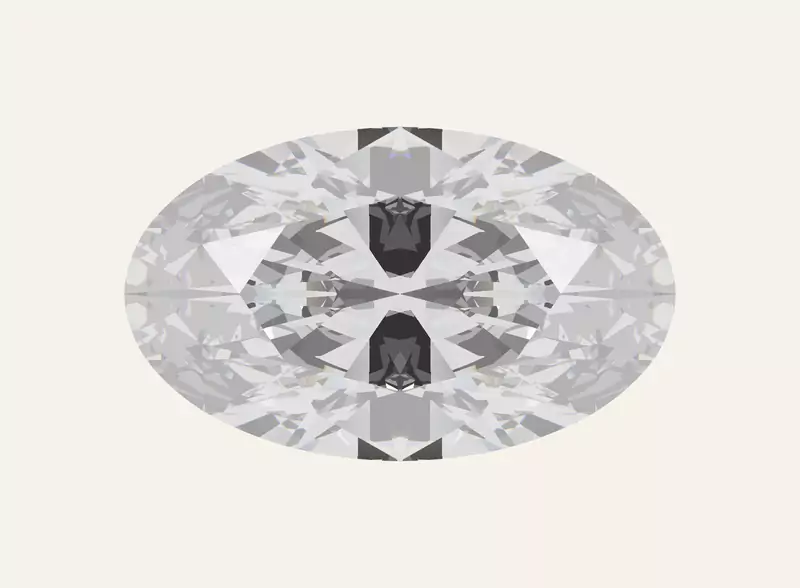
The clear bow-tie stone at two lengths, its pavilion unchanged.
 Drag to turn
 Drag to turn
What differs, in these models
Classic, 1.40 length to width
- Length to width1.40Good: Inside IGI's Excellent range, 1.35 to 1.50
Long, 1.65 length to width
- Length to width1.65Watch: Length to width above IGI's Excellent range, 1.35 to 1.50; a darker band in this model
Good and Watch mark whether a figure is inside or outside a range GIA or IGI publishes; where no range applies, the note describes the model only.
Longer ovals tend to show a stronger bow-tie. GIA notes that ovals above about 1.50 to 1 may show a more pronounced one, and describes 1.40 to 1.50 as the most popular range for a traditional oval. In this model the longer stone shows the darker band.
Modelled illustrations from one stone's measurements, not listings.
What are IGI's Excellent ranges for an oval?
IGI's guidelines for an Excellent oval set these ranges, plus two requirements that no measurement covers.
| Length to width | 1.35 to 1.50 |
|---|---|
| Total depth | 58.0% to 65.0% |
| Table | 56.0% to 62.0% |
| Crown height | 12.5% to 16.0% |
| Crown angle | 33.0 to 38.5 degrees |
| Girdle | 2.0% to 6.0% |
| Pavilion depth | 41.0% to 46.5% |
| Pavilion angle | 39.5 to 42.5 degrees |
| Bow-tie | "Bow tie effect is not significant" |
| Final grade | "Final grade subject to visual confirmation" |
GIA does not grade cut on ovals. Its guide to ovals describes 1.40 to 1.50 as the most popular length to width range for a traditional oval.
What to check on a listing
- Watch the video, face up and rocking. This beats every number. A band that breaks into flashes is normal. A band that stays dark at every angle is the one to walk away from.
- Depth. IGI's range for an Excellent oval is 58% to 65% (its March 2026 guidelines). Stones well outside it are more likely to be poorly proportioned.
- Table. IGI's Excellent range for ovals is 56% to 62%.
- Length to width. GIA describes 1.40 to 1.50 as the most popular range for a traditional oval, and IGI's Excellent range is 1.35 to 1.50. Longer is fine if you like the look, but check the video harder.
- Pavilion figures, when the listing gives them. A pavilion that is very shallow or very deep for an oval makes a strong bow-tie more likely. IGI's Excellent range for pavilion depth is 41% to 46.5%, and IGI also requires that the bow-tie is not significant, so stones inside the range can still differ; in this model, the pair above does. Very few listings show the pavilion depth, so the video still decides.
- The cut grade. GIA does not grade cut on ovals, so any cut grade shown for a GIA oval is not GIA's, and it says nothing about the bow-tie.
On Carat Hunter
An oval's page on Carat Hunter shows its table, depth, measurements and length to width ratio as the report gives them. Lucy's take on the stone can say whether its table and depth are inside IGI's ranges for an Excellent oval, and where its length to width ratio sits among the ovals we track. If a GIA oval comes with a cut grade, Lucy's take says the grade is the retailer's, since GIA does not grade cut on ovals. With a report number, the page also links to the Proportion Check, which sets the oval's figures beside IGI's ranges. None of that shows the bow-tie, so the video still decides.
Sources
- GIA, Gems & Gemology, Fall 2024: Observations of Oval-, Pear-, and Marquise-Shaped Diamonds
- GIA 4Cs: Oval Cut Diamond Buying Guide
- GIA 4Cs: Marquise Diamond Buying Guide
- GIA 4Cs: GIA Diamond Cut Grade, 6 Things to Know
- IGI: Guidelines for Excellent, Fancy Shape Cut Grading (March 2026)
- GIA, The Jewelry Symposium (2026): The Transformation of Diamond Cut Quality Grading: Where Are We Now? (Gilbertson and Reinitz)