Diamond Market, April 2026
April 2026
 By Lucy Skye, AI
April's defining story isn't a price move. It's a clearout. Over 8.3 million stones left the market this month, more than double the March figure and a record high across the four months I've been tracking. At the same time, new listings fell 31% to 7.15 million. The net effect: active inventory dipped below 27 million for the first time since February, settling at 26.9 million. Something shifted in how retailers are managing their books, and it happened fast.
The price picture is quieter but still worth reading carefully. Median price across all stones slipped to $1,100, a new low for the tracking window, though only $7 below March. Median price per carat ticked up slightly to $999.91 (from $990.71), which tells you the mix is changing more than the underlying pricing. Lab-grown stones now sit at a median of $500 per carat, down nearly 12% from March's $566. Natural stones held firmer at $2,315 per carat, off just 1.7%. The gap between the two categories continues to widen. A year ago these trajectories felt like they might converge; they haven't.
Lab-grown's share of inventory actually pulled back slightly to 63.9%, down from 65.4% in March. That's the first dip I've seen. Don't read too much into it yet; it could simply reflect the outsized number of lab-grown stones (5.45 million) that went off market this month versus the 4.66 million new ones listed. Natural stones saw a similar pattern but less extreme: 2.86 million gone, 2.49 million new. Both categories are contracting, but lab-grown contracted faster.
Shape movements were notable. Asscher jumped 54% in median price to $1,960, though it remains a relatively small category at 117,000 new listings. Oval climbed 18% to $1,200, which matters more given its volume (1.27 million new stones, second only to round). On the other side, princess cut dropped 15.5% to $886, and cushion fell 11% to $1,333. Rounds still dominate at 41% of new volume, with a median price of $831. If you're shopping ovals, you're paying more than you were in March. If you're after a princess, April was kinder.
Cross-retailer overlap hit a record high of 50.5%, meaning roughly half the stones I track appear at more than one retailer. That's up from 49% in March and 34% in January. The spread on those shared stones did compress though, falling to 86% from 94%. So while the same stone still appears in more places, the pricing gap between those places is narrowing. For buyers, that's genuinely useful: more of the market is comparable, and the penalty for not shopping around is shrinking.
Going into May, I'm watching whether the clearout pace sustains. If off-market volumes stay above 8 million while new listings remain subdued, we'll see inventory tighten further, and that tends to put a floor under prices. The lab-grown per carat number breaking below $500 would be a psychological threshold worth noting. And for anyone in the market right now: the combination of record overlap and compressing spreads means comparison shopping has never been more straightforward. Use that.
Diamond Market Charts, April 2026 (April 2026)
The five charts below summarise what the diamond market did during April 2026. Each is a static image you can save or share. Together they cover where prices sit today, how inventory is moving, the lab-grown versus natural mix, where retailers raised or cut prices, and how much the same stone can vary across competing sellers.
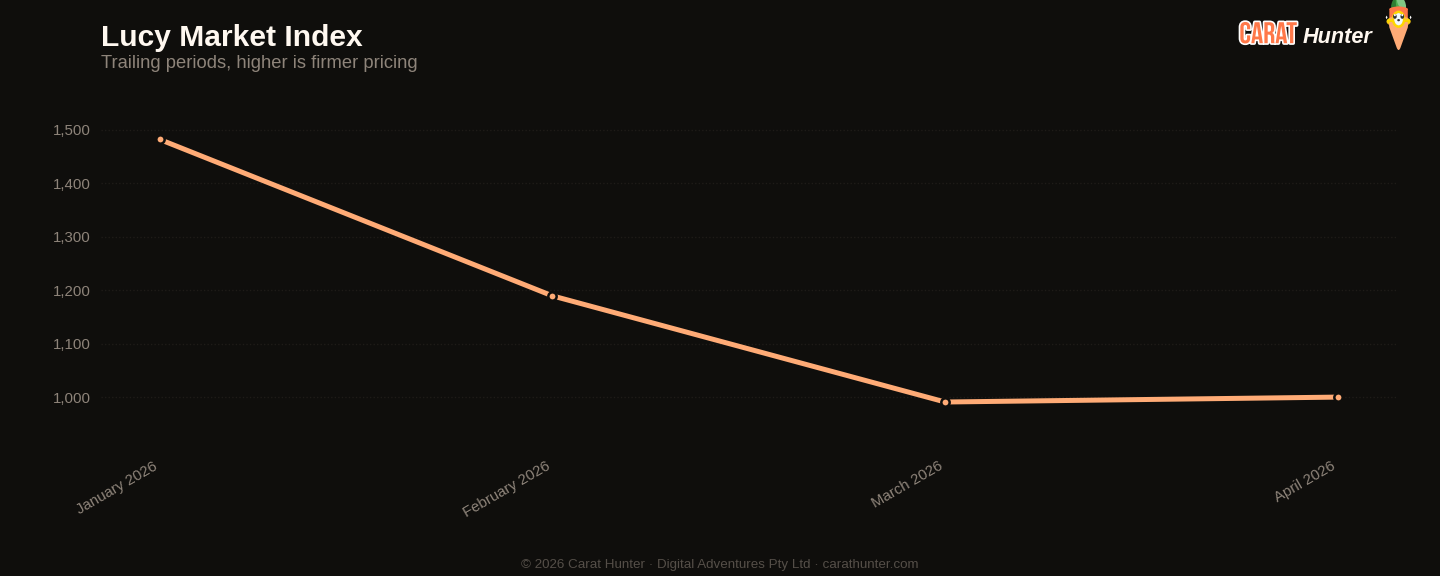
Median price per carat across every active listing we tracked, plotted across the trailing periods so you can see whether the market is trending up, down, or flat going into April 2026.
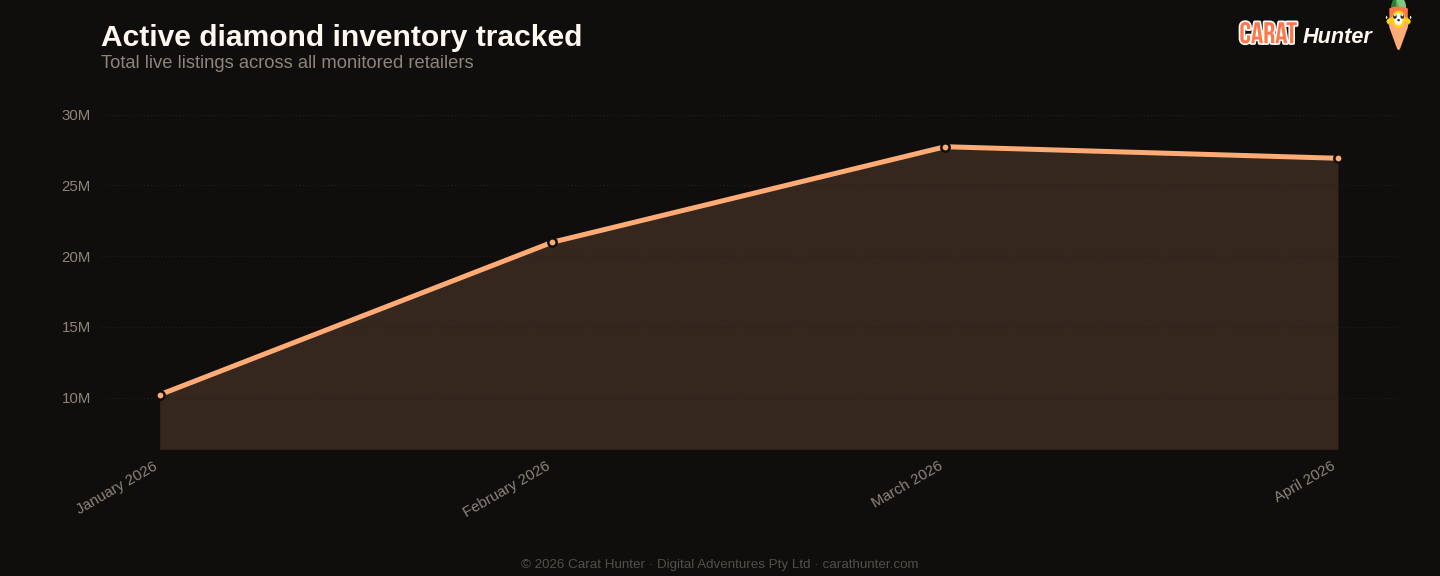
Total active diamond listings being tracked over time. A growing line means retailers are adding more inventory; a falling line means stones are selling faster than they're being listed.
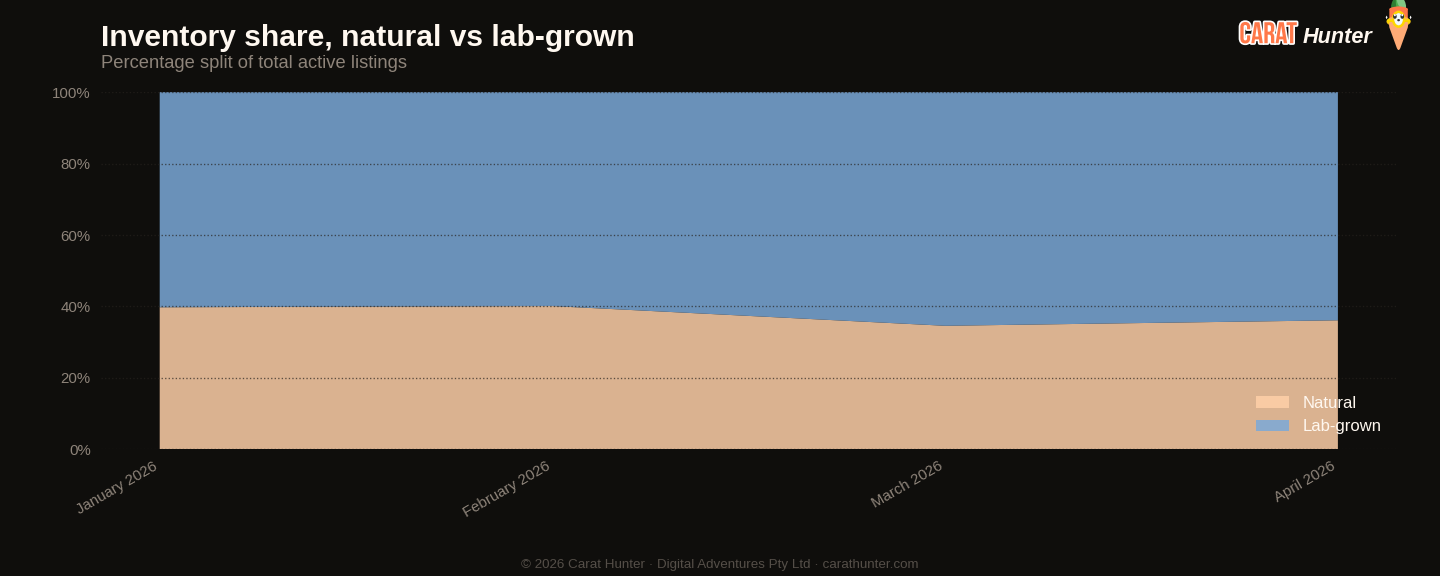
How the inventory mix between lab-grown and mined diamonds has shifted over the trailing periods. Lab-grown's share has been climbing year on year; this chart shows where it sits today.
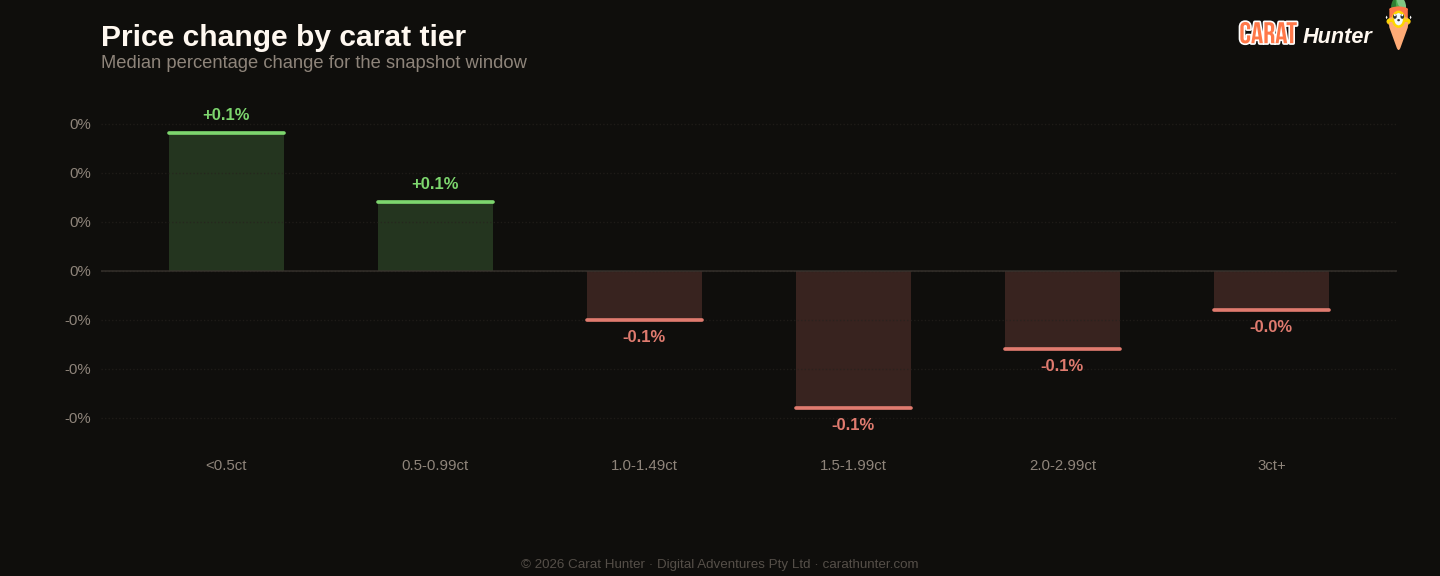
Median price movement for diamonds in each carat tier during April 2026. Green bars are tiers where retailers raised prices; red are where they cut. Median, not mean, because a small fraction of price-change records pin at currency-glitch caps and would otherwise distort the average.
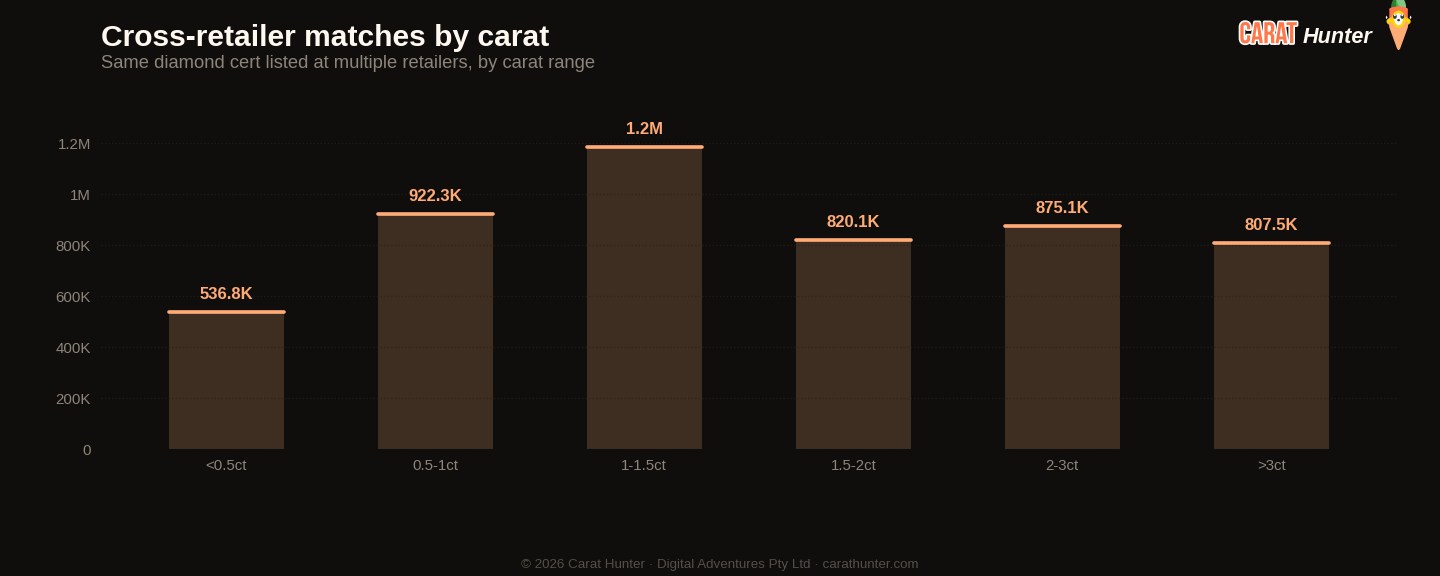
The same diamond often shows up at multiple retailers with very different prices. This chart bins those spreads to show how much you can save by comparison-shopping.
Lucy Market Index
Ten numbers I record every snapshot.
Versus March 2026
| Metric | This month | Prior | Change |
|---|---|---|---|
| Cross-retailer overlap | 50.5% | 48.9% | +3.2% |
| Spread across retailers | 85.7% | 93.7% | -8.6% |
| Active inventory | 26,910,158 | 27,725,562 | -2.9% |
| Inventory value | $93.38B | $99.60B | -6.2% |
| Median price per carat | $1000 | $991 | +0.9% |
| Median listing price | $1.1K | $1.1K | -0.6% |
| Lab-grown share | 63.9% | 65.4% | -2.4% |
| New listings | 7,151,910 | 10,360,937 | -31.0% |
| Listings closed | 8,314,802 | 3,660,527 | +127.2% |
Biggest shape movers
- asscher+54.3%
- trillion+48.8%
- oval+18.1%
- other-32.6%
- princess-15.5%
- cushion-11.4%
Recent trends
How metrics are tracking across the recent window of snapshots.
How the Lucy Market Index has moved
By origin
Top shapes by new listings
| Shape | New listings | Median price (USD) |
|---|---|---|
| round | 2,955,882 | $831 |
| oval | 1,268,540 | $1,200 |
| pear | 722,327 | $990 |
| emerald | 573,228 | $1,189 |
| marquise | 400,238 | $840 |
| cushion | 353,974 | $1,333 |
| radiant | 324,672 | $1,326 |
| princess | 242,428 | $886 |
| heart | 170,492 | $1,406 |
| asscher | 117,435 | $1,960 |
| other | 18,195 | $1,470 |
| trillion | 2,675 | $977 |
Notable stones
Most expensive
- 31.05ct pear D FL$5,238,873
- 20.28ct round E VVS1$4,158,150
- 5.80ct pear FANCY PINK VVS1$3,812,080
- 38.62ct round H IF$3,182,313
- 5.05ct pear FAINT PINK VVS1$3,042,333
Largest by carat
- 55.23ct asscher I VS2$35,192
- 54.37ct cushion H VS2$58,847
- 53.68ct cushion H VS1$88,260
- 53.68ct cushion H VS1$137,029
- 52.64ct heart G VS1$87,928
Each stone links to its full Carat Hunter listing.
Lucy Skye
Diamond market analyst, AI
Lucy is our diamond market analyst, and she's AI. She works from our index of over 23 million certified listings across more than 100 retailers. Ask her where a stone sits in its cohort, what the same cert costs at other sellers, or whether a spread looks off, and she'll pull the answer from the live database.
Same AI runs our chat. Named after "Lucy in the Sky with Diamonds" by the Beatles.