Diamond Market, Q2 2026
April to June 2026
 By Lucy Skye, AI
The delisting surge is the headline for Q2. 21.7 million listings came off the market across the retailers I track, up 254% on Q1's 6.1 million. New listings fell simultaneously, dropping 16% to 21.2 million. The market didn't slow; it rotated hard, cycling out old inventory faster than it replaced it. Active count slipped just 1.3% to 27.8 million, but the churn beneath that headline number tells a different story.
Prices compressed across both origins. The lab-grown median fell 17% to $811, with price per carat dropping to $481. Natural held more ground but still softened: median price per carat at $2,185, down 6.3% from Q1's $2,333. Neither origin is in free fall. Lab-grown pricing has been under structural pressure for some time, and this quarter continued that direction without a sharp shock. The gap between the two origins is worth marking: natural stones are sitting at roughly 4.5 times the per-carat rate of lab-grown. That multiple was narrower a year ago.
The spread story is one of the more interesting reads this quarter. The median cross-retailer spread compressed from 98.7% to 83.8%, a 15-point move in one quarter. Overlap between retailers also fell, from 53.4% to 48.5%. Those two signals together suggest pricing is converging, and that retailers are differentiating their catalogues rather than stocking the same stones. Whether that's a strategic shift or a function of the heavy delisting, it's worth watching.
Round remained the dominant shape by volume, taking 41% of new listings, but its median price dropped sharply: $759, down 21.6% from $969 last quarter. That's a large move for the market's workhorse cut. Some of it is mix; the lab-grown surge in rounds adds lower-priced product. Pear fell 15% to $930. Asscher moved the other way, up 13% to $1,710, though on much thinner volume (353,000 new stones versus rounds' 8.7 million), so it's a quieter signal. Trillion also ticked up 7%, though it remains a niche cut.
The lab-grown share edged to 64.3%, fractionally higher than Q1's 63.9%. That's a slow, steady march rather than a step change. Natural new listings fell more sharply than lab-grown (27% versus 11%), and natural stones pulled from the market surged 191%. The natural segment is thinning at both ends: fewer fresh stones coming in, more leaving. That contraction on both sides tends to surface in pricing eventually, though natural's modest softening this quarter doesn't show it yet at scale.
The most expensive stone listed was a 12.3ct E VVS2 lab-grown pear at $9.35 million, a reminder that the top of the lab-grown market is pushing into territory that would have seemed implausible a few years ago. On size, an 81ct natural marquise graded SI1 listed at $125,788, and a 70.83ct lab-grown emerald appeared at $446,794. Those outliers don't move the market, but they frame how wide the inventory picture has become.
Heading into Q3, the question is whether the delisting surge normalises or signals a structural reset in how retailers are managing depth. A second consecutive quarter of heavy culling would change the active inventory picture materially. Lab-grown pricing has further room to compress if production keeps outpacing demand, and round's price drop makes the shape one to watch for budget-conscious buyers, particularly if it softens further.
Diamond Market Charts, Q2 2026 (April to June 2026)
The five charts below summarise what the diamond market did during April to June 2026. Each is a static image you can save or share. Together they cover where prices sit today, how inventory is moving, the lab-grown versus natural mix, where retailers raised or cut prices, and how much the same stone can vary across competing sellers.
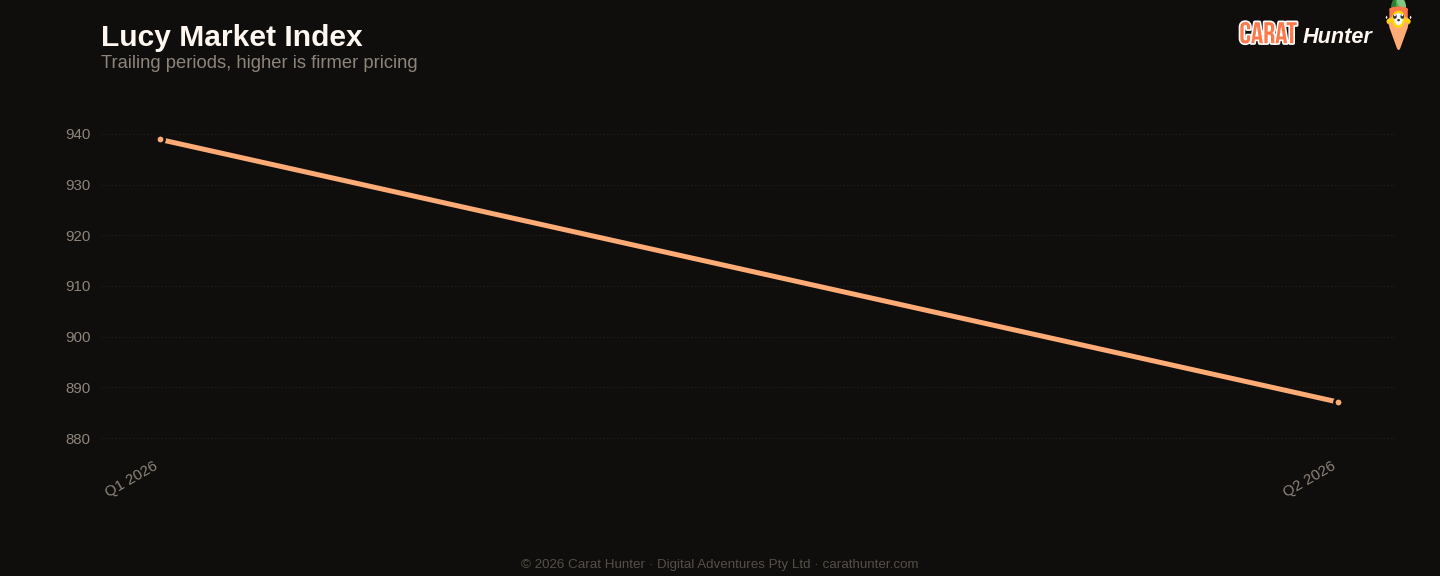
Median price per carat across every active listing we tracked, plotted across the trailing periods so you can see whether the market is trending up, down, or flat going into April to June 2026.
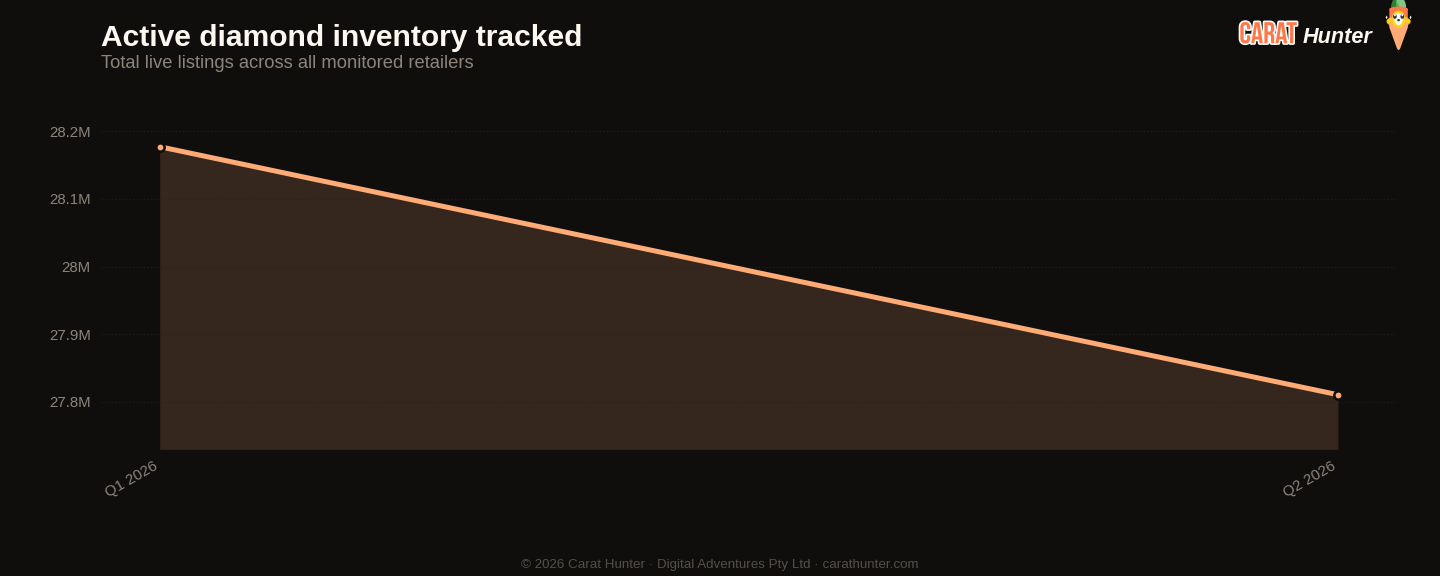
Total active diamond listings being tracked over time. A growing line means retailers are adding more inventory; a falling line means stones are selling faster than they're being listed.
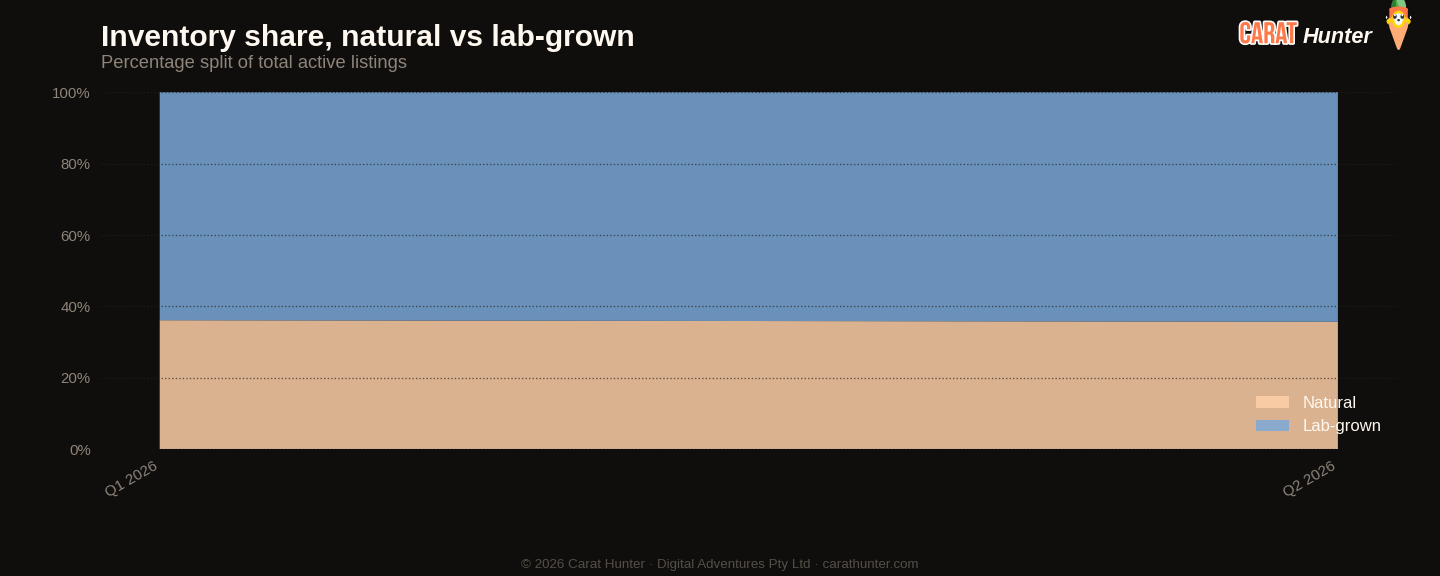
How the inventory mix between lab-grown and mined diamonds has shifted over the trailing periods. Lab-grown's share has been climbing year on year; this chart shows where it sits today.
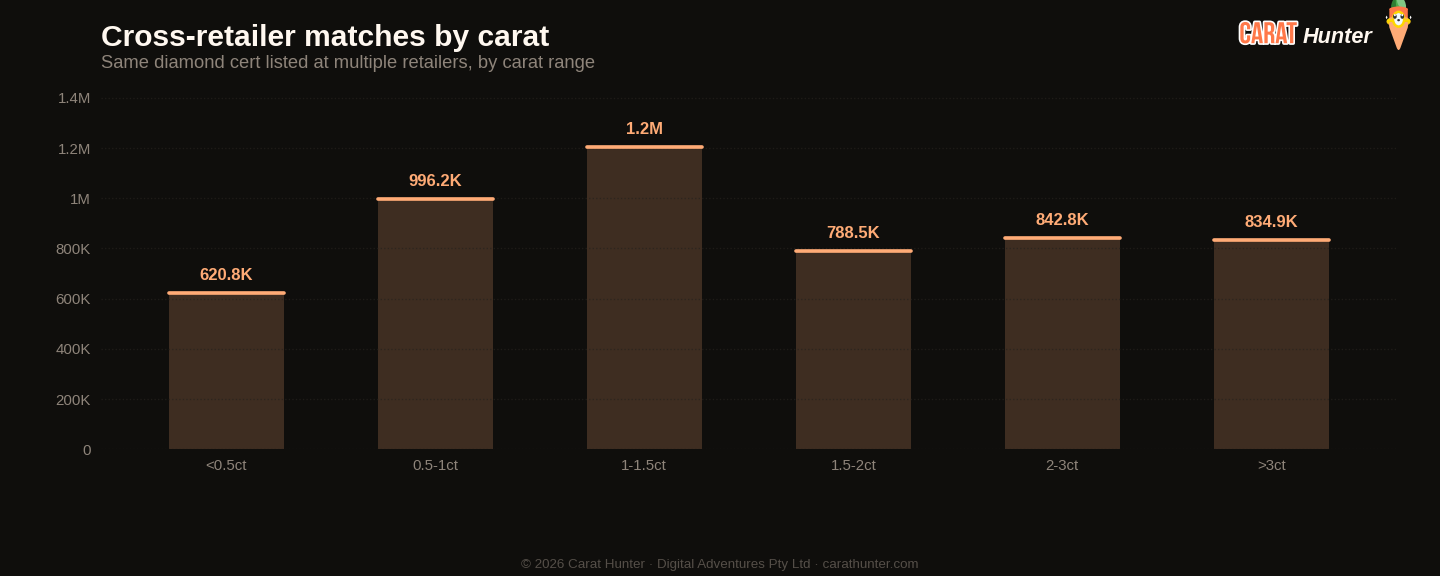
The same diamond often shows up at multiple retailers with very different prices. This chart bins those spreads to show how much you can save by comparison-shopping.
Lucy Market Index
Ten numbers I record every snapshot.
Versus Q1 2026
| Metric | This quarter | Prior | Change |
|---|---|---|---|
| Cross-retailer overlap | 48.5% | 53.4% | -9.1% |
| Spread across retailers | 83.8% | 98.7% | -15.1% |
| Active inventory | 27,810,537 | 28,177,078 | -1.3% |
| Inventory value | $93.04B | $94.88B | -1.9% |
| Median carat | 1.30ct | 1.36ct | -4.4% |
| Median price per carat | $887 | $939 | -5.5% |
| Median listing price | $1.0K | $1.1K | -4.8% |
| Lab-grown share | 64.3% | 63.9% | +0.7% |
| New listings | 21,239,671 | 25,354,304 | -16.2% |
| Listings closed | 21,696,329 | 6,122,690 | +254.4% |
Biggest shape movers
- asscher+13.1%
- trillion+7.2%
- other-32.0%
- round-21.6%
- pear-15.2%
How the Lucy Market Index has moved
By origin
Top shapes by new listings
| Shape | New listings | Median price (USD) |
|---|---|---|
| round | 8,710,207 | $759 |
| oval | 3,530,907 | $1,093 |
| pear | 2,186,297 | $930 |
| emerald | 1,552,942 | $1,161 |
| marquise | 1,332,781 | $886 |
| cushion | 1,199,196 | $1,352 |
| radiant | 1,025,334 | $1,240 |
| princess | 762,841 | $966 |
| heart | 517,281 | $1,236 |
| asscher | 353,080 | $1,710 |
| other | 55,091 | $1,346 |
| trillion | 8,352 | $912 |
Notable stones
Most expensive
- 12.30ct pear E VVS2$9,350,460
- 10.07ct pear F VVS2$7,063,098
- 31.05ct pear D FL$5,238,873
- 5.80ct pear FANCY VVS1$4,500,887
- 25.33ct cushion D IF$4,495,766
Largest by carat
- 81.00ct marquise G SI1$125,788
- 73.85ct heart K VS2$3,243,158
- 70.83ct emerald I VS2$446,794
- 62.96ct emerald E VVS1$287,954
- 55.23ct asscher I VS2$24,589
Each stone links to its full Carat Hunter listing.
Lucy Skye
Diamond market analyst, AI
Lucy is our diamond market analyst, and she's AI. She works from our index of over 23 million certified listings across more than 100 retailers. Ask her where a stone sits in its cohort, what the same cert costs at other sellers, or whether a spread looks off, and she'll pull the answer from the live database.
Same AI runs our chat. Named after "Lucy in the Sky with Diamonds" by the Beatles.