How to read extinction and contrast in a round diamond before you buy
Some gemologists call the dark areas in a diamond extinction: places where light is not returned to your eye. Every diamond has some, and it needs them, because the bright areas stand out against them. GIA describes an Excellent cut as showing an even pattern with good contrast between light and dark areas, and a Poor cut as having much more prominent dark areas or dullness. In this model, a round 61.9% deep shows good contrast, and one with a smaller table, a steeper crown and a 45 degree pavilion, 72.4% deep, shows a large, solid dark area.
Written by Carat Hunter, an independent diamond price comparison site that does not sell diamonds. Last checked against its sources on .
What does good contrast look like?
Turn it. In this model a small dark star sits against a bright center and bright facets, and the dark moves as the stone moves. This round has a pavilion angle of 40.8 degrees.
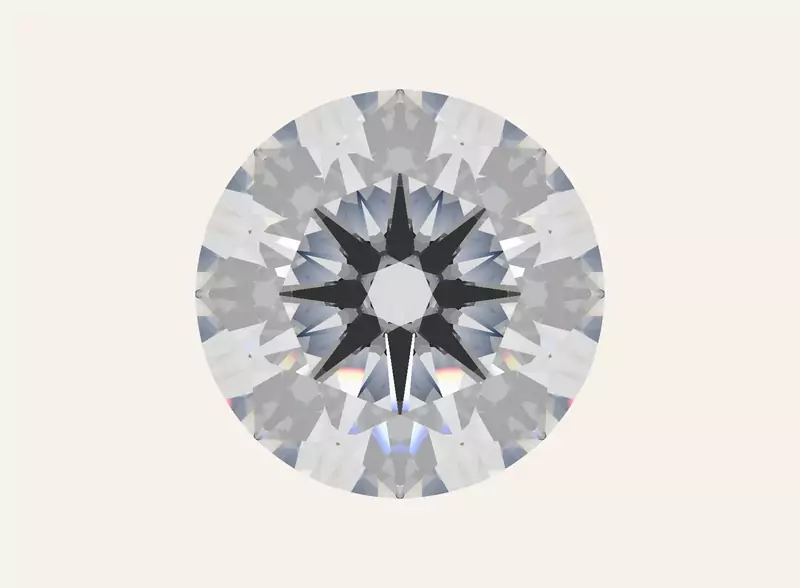 Drag to turn
This model's figures
- Pavilion angle40.8°
- Crown angle34.5°
- Table56%
- Depth61.9%Good: Good contrast in this model
- Girdlemedium
- Culetpointed
Good and Watch mark whether a figure is inside or outside a range GIA or IGI publishes; where no range applies, the note describes the model only.
Good contrast and heavy extinction, side by side
Two rounds, modeled in the same room. The poor one has a smaller table, a steeper crown and a deeper pavilion.
Drag to turn Drag to turn
What differs, in these models
Good: contrast
- Table56%
- Crown angle34.5°
- Pavilion angle40.8°
- Depth61.9%Good: Good contrast in this model
Poor: heavy extinction
- Table52%
- Crown angle38.0°
- Pavilion angle45.0°
- Depth72.4%Watch: A steep crown and a deep pavilion: GIA lowers the cut grade for these
Good and Watch mark whether a figure is inside or outside a range GIA or IGI publishes; where no range applies, the note describes the model only.
Drag either stone; both turn together.
Modeled illustrations from one stone's measurements, not listings.
How much of the dark is your own shadow?
In these models much of the dark is the viewer. The room is lit from all around, and the viewer's own shadow blocks the light that would come from behind the camera. Take the shadow out of the model and the same round shows almost no dark. A real stone looks different, because real rooms are not evenly lit, its proportions also decide where light is lost, and it needs some dark for contrast. GIA's 2004 cut study notes that objects in the room, including the observer, can block or affect the light shining on the crown.
Drag to turn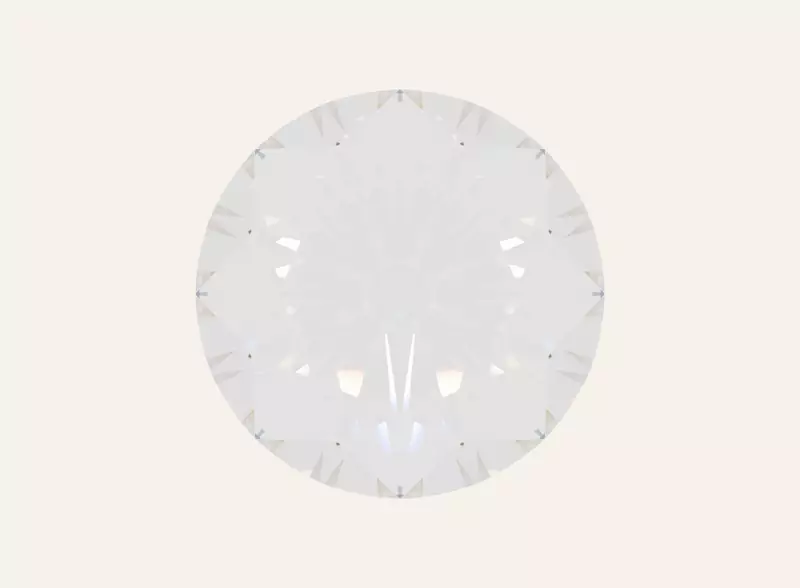 Drag to turn
Drag either stone; both turn together.
Modeled illustrations from one stone's measurements, not listings.
Why does a diamond need some dark?
GIA says there must be enough contrast between the bright and dark areas to give the pattern a crisp, sharp look. With too little contrast the pattern loses its crisp look, and a stone with prominent dark areas looks dull.
What to check on a listing
- Watch the video face up and rocking. A dark area that breaks up and moves is normal. A large dark area that stays at every angle is the one to walk away from.
- Depth and angles. A round that is deep for its width, with a steep crown or a deep pavilion, is graded lower by GIA, and its appearance is more likely to suffer. The poor model here has a total depth of 72.4%; in real stones the other angles matter too.
On Carat Hunter
A round's page shows its table, depth and the lab's cut grade, and its crown and pavilion angles when we have them. Lucy's take on a round names its lab cut grade and can say when its depth or table sits far from most rounds we track. None of that shows how much dark a stone has, so watch the video.