How to spot a window in a diamond before you buy
A window is a patch in the middle of a diamond where you see through the stone, so it takes on the look of whatever is behind it. It comes from a pavilion cut too shallow: light that should bounce back up to your eye leaks out through the bottom instead. GIA reports have no line for windows, and GIA does not grade cut on ovals, so you judge it yourself. In this model, an oval with a 44% pavilion depth and 61.6% total depth hides a printed grid, and the same oval at 36% and 53.6% shows the grid through its center.
Written by Carat Hunter, an independent diamond price comparison site that does not sell diamonds. Last checked against its sources on .
What does a good stone look like over print?
Set over a printed grid, a well-cut oval hides it. The center is full of reflections, not lines.
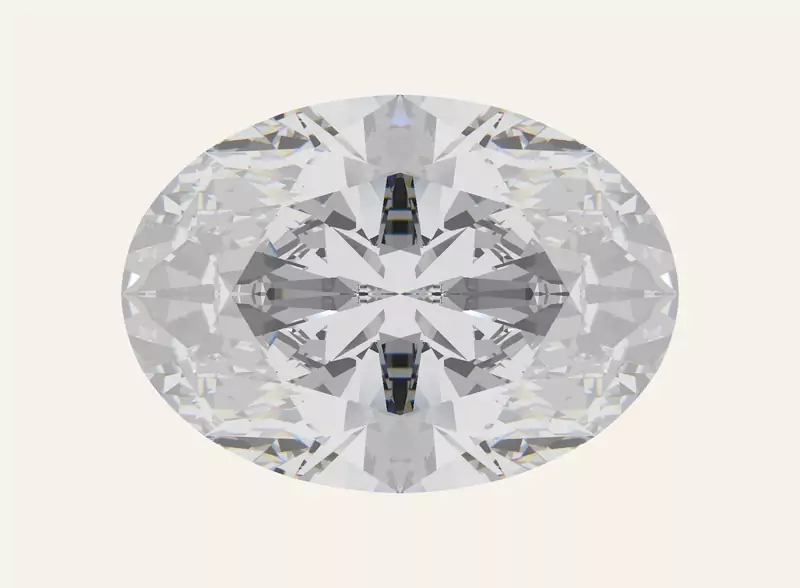 Drag to turn
This model's figures
- Length to width1.40
- Table58%
- Depth61.6%Good: Inside IGI's Excellent range, 58% to 65%
- Pavilion depth44%
- Girdlemedium
- Culetpointed
Good and Watch mark whether a figure is inside or outside a range GIA or IGI publishes; where no range applies, the note describes the model only.
A good and a windowed oval, side by side
One oval, modeled twice over the same printed grid. Only the pavilion changes.
Drag to turn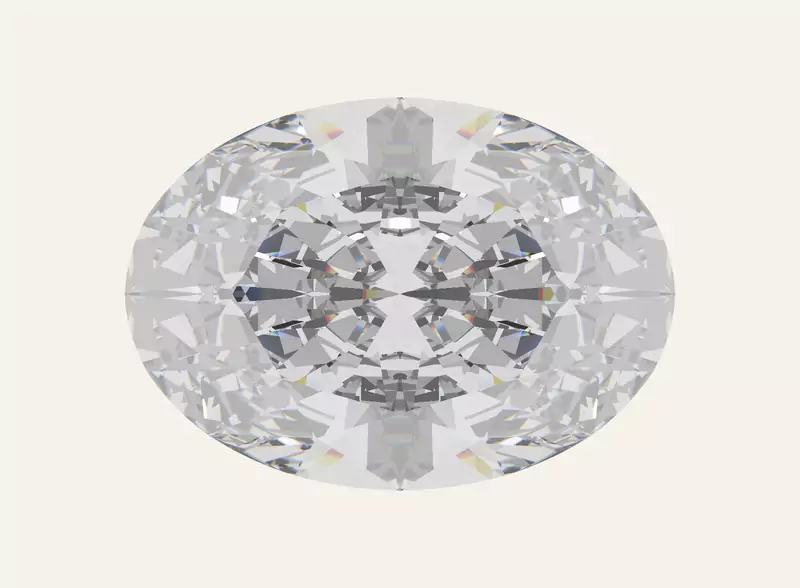 Drag to turn
What differs, in these models
Good: no window
- Pavilion depth44%
- Depth61.6%Good: Inside IGI's Excellent range, 58% to 65%
Poor: windowed
- Pavilion depth36%
- Depth53.6%Watch: Well under IGI's 58% depth: a shallow pavilion is more likely, and a shallow pavilion can leave a window
Good and Watch mark whether a figure is inside or outside a range GIA or IGI publishes; where no range applies, the note describes the model only.
Drag either stone; both turn together.
Modeled illustrations from one stone's measurements, not listings.
Why can a photo hide a window?
Against a plain white background a window can look bright, so a photo may not show it. Over anything darker or patterned, or in a video as the stone turns, it is easier to see.
Does a window matter?
In GIA's 2024 study of ovals, pears and marquises, observers disliked diamonds with large windows, and they agreed most strongly when the window looked dark.
Fish-eye, dark center or window?
All three make the middle of a diamond look wrong, and you tell them apart by what you see. GIA's research links a fish-eye to a pavilion cut too shallow and a dark center to one cut too deep, and a window also comes from a shallow pavilion. The figures below are this site's models, not limits for real stones.
- Fish-eye
- A pale or gray ring just inside the edge of the table: the girdle, reflected. In this model it shows in a round with a 37 degree pavilion angle, 56.4% deep.
- Dark center
- A dull patch in the middle of the table that stays dark when the stone is tilted. In this model it shows in a round with a 45 degree pavilion angle, 68.7% deep.
- Window
- A see-through middle that takes on the look of whatever is behind the stone. In this model it shows in an oval with a 36% pavilion depth, 53.6% deep.
In these models, the round with a 40.8 degree pavilion angle, 61.9% deep, shows neither a ring nor a dark center, and the oval with a 44% pavilion depth, 61.6% deep, shows no window.
What to check on a listing
- Watch the video over a darker or patterned background. A center that looks the same as the background is the sign.
- Depth. IGI's range for an Excellent oval is 58% to 65% (its March 2026 guidelines). A stone well under 58% deep is more likely to have a shallow pavilion, and so a window.
- Pavilion figures, when the listing gives them. A shallow pavilion is the cause.
- Size for its weight. A stone that faces up much larger than others of the same carat has too little weight for its diameter, which GIA's cut system treats as a weight ratio fault, and may be cut shallow. Lucy's take can say when a stone faces up larger than most of the same weight.
- Emerald and Asscher cuts can show a window too, so watch their videos the same way.
On Carat Hunter
A stone's page shows its depth as the report gives it. For an oval, Lucy's take can compare the depth with IGI's range for an Excellent oval; for a round, it can say when the depth is shallower than most rounds we track. It can also say when a stone faces up larger than most of its shape and weight, which is a reason to check the video for a window.
Sources
- GIA, Gems & Gemology, Fall 2024: Observations of Oval-, Pear-, and Marquise-Shaped Diamonds
- GIA 4Cs: Oval Cut Diamond Buying Guide
- GIA 4Cs: GIA Diamond Cut Grade, 6 Things to Know
- IGI: Guidelines for Excellent, Fancy Shape Cut Grading (March 2026)
- GIA 4Cs: Diamond Cut
- GIA: GIA Researchers Evaluate ‘Light Performance’ and Diamond Cut
- GIA: Estimating a Cut Grade Using the GIA Diamond Cut Grading System