How to spot a large culet in a round diamond before you buy
The culet is the small facet at the very bottom of a diamond, and when it is large it can show face up as a small circle in the center. Reports grade it on a scale from None to Extremely Large, and GIA puts none, very small and small in its Excellent range. In this model, a round with a pointed culet shows no circle, and the same round with a very large culet shows a clear one.
Written by Carat Hunter, an independent diamond price comparison site that does not sell diamonds. Last checked against its sources on .
What does a good culet look like face up?
Turn it. The center is a bright point with no circle. This round has a pointed culet.
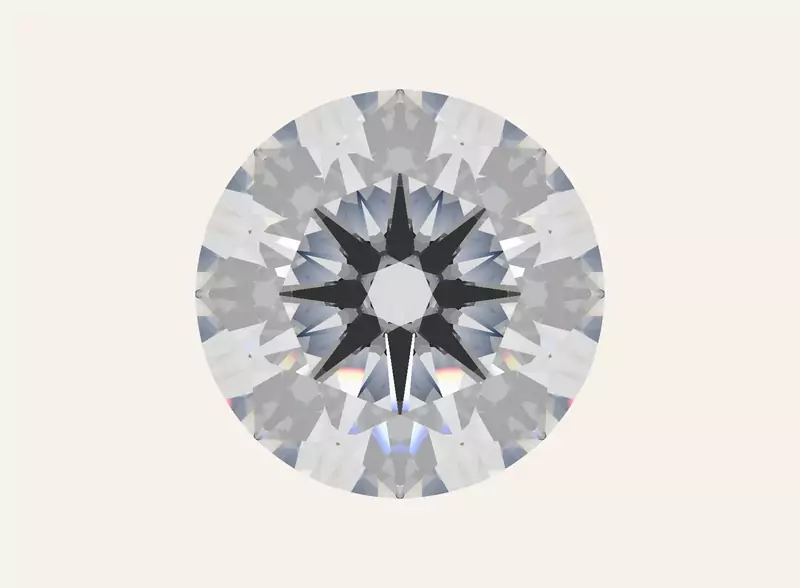 Drag to turn
This model's figures
- Pavilion angle40.8°
- Crown angle34.5°
- Table56%
- Depth61.9%
- Girdlemedium
- CuletpointedGood: A pointed culet leaves no circle in this model
Good and Watch mark whether a figure is inside or outside a range GIA or IGI publishes; where no range applies, the note describes the model only.
A pointed and a very large culet, side by side
One round of about 1 ct, modeled twice. Only the culet changes.
Drag to turn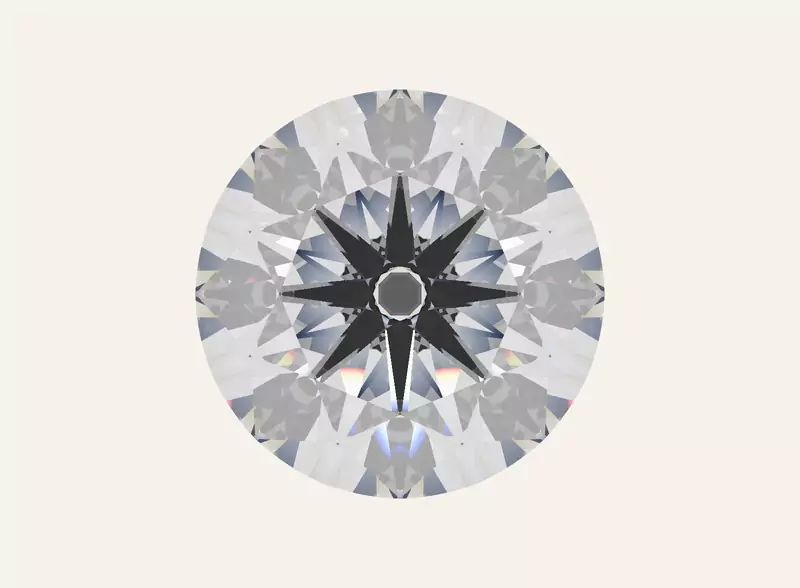 Drag to turn
What differs, in these models
Good: pointed culet
- CuletpointedGood: A pointed culet leaves no circle in this model
Poor: very large culet
- Culetvery largeWatch: Very large: not one of the culet sizes in GIA's Excellent range, none, very small and small
Good and Watch mark whether a figure is inside or outside a range GIA or IGI publishes; where no range applies, the note describes the model only.
Drag either stone; both turn together.
Modeled illustrations from one stone's measurements, not listings.
Can you see a large culet face up?
It can. GIA's booklet on estimating a cut grade says a very large culet would be a light or dark spot in the center of the pattern. In this model, light that reaches the culet passes out of the bottom instead of returning to the viewer, so a larger culet shows as a larger dark circle. In real stones, as GIA's words say, it can look light or dark.
What does the culet line on a report mean?
GIA describes a culet's size in words; its graders make the final call by eye, with percentages of the diameter as a guide.
- None
- Very Small
- Small
- Medium
- Slightly Large
- Large
- Very Large
- Extremely Large
Does culet size affect the cut grade?
On a standard round brilliant it can. GIA's booklet on estimating a cut grade lists the best cut grade each culet size allows:
| Excellent | culet from none to small |
|---|---|
| Very Good | culet from none to medium |
| Good | culet from none to large |
| Fair | culet from none to very large |
| Poor | culet from none to extremely large |
Each row is the best grade a culet of that size allows; the stone's other measurements can still lower it.
What to check on a listing
- Culet size on the report. Reports grade it on a scale from none up to extremely large. None, very small and small fall in GIA's Excellent range. Medium and larger are worth a close look, and large to extremely large most of all.
- Look at the center of the face-up photo or video. A small circle in the exact center of the table may be the culet.
- Check that it sits in the middle. A culet you can see face up should sit in the center of the table. One that sits to one side is an off-center culet, one of the features that lower symmetry. Off-center culet and table
On Carat Hunter
A stone's page shows its culet size as the report gives it. Lucy's take on the stone can say when the culet is large or larger, a size that can show as a small dot in the middle when you look straight down, and, for a fancy shape IGI covers, when the culet is larger than IGI's Excellent range allows.
Sources
- GIA 4Cs: Diamond Cut
- GIA 4Cs: GIA Diamond Cut Grade, 6 Things to Know
- GIA 4Cs: Diamond Anatomy, Explained
- GIA: Finish, Culet Size, and Girdle Thickness: Categories of the GIA Diamond Cut Grading System
- GIA: Estimating a Cut Grade Using the GIA Diamond Cut Grading System
- GIA 4Cs: Oval Cut Diamond Buying Guide