How to read an ASET image of a diamond
An ASET image shows a diamond face up in false color: each part of the stone takes the color of the direction its light comes from. AGS Laboratories developed the tool with an optical scientist at the University of Arizona, and GIA offers an ASET Map as an option on the AGS Ideal Report. The stones on this page are our models, lit the same way, so the colors move as you turn them.
Written by Carat Hunter, an independent diamond price comparison site that does not sell diamonds. Last checked against its sources on .
What is an ASET image?
ASET stands for Angular Spectrum Evaluation Tool. In GIA's words, the technology "was created to be a visual guide of a diamond's cut grade." AGS Laboratories developed it with José Sasián, an optical scientist at the University of Arizona (Sasián and colleagues, 2007), and its patent, which names him first among its inventors, dates from the early 2000s.
The instrument its developers describe has "a stage where the gem is placed, a hemisphere carrying the colors according to angular range, a light source, and a camera" (Sasián and colleagues). The patent also describes a simpler viewer: a colored hemispherical reflector, lit by the light of the room, with an eyepiece to look through.
The ASET Map on an AGS Ideal Report is made another way. GIA says software traces individual rays of light to map the diamond's performance, so the map is computed, not photographed.
What does each color in an ASET image mean?
Each color stands for a band of directions the light arrives from, measured as an angle up from the plane of the table, where 90 degrees is straight above the stone: green from 0 to 45 degrees, red from 45 to 75, and blue from 75 to 90 (Sasián and colleagues; GIA).
- Blue, 75 to 90 degreesGIA calls it "a contrast pattern of dark reflections." These directions are close to the viewer's own line of sight: "Rays from these directions are usually obscured by an observer's head" (the patent).
- Red, 45 to 75 degreesGIA calls these "the brightest areas of the diamond that attract the brightest light from above." Light usually reaches a diamond from these directions, and under typical viewing conditions the viewer does not block them (the patent).
- Green, 0 to 45 degreesGIA says green "also indicates light return, but from an indirect source which is not as bright." The patent notes that these low directions do not usually give much light, though they can show as sparkle when the stone, the viewer or the light moves.
- Gray, white or black, below 0 degreesLight from below the table plane, from behind the stone, is leakage. The developers' computed maps show it gray (Sasián and colleagues). Through a viewer it can look white or black, depending on whether light reaches the stone from behind (the patent).
What does a well-cut round look like in ASET?
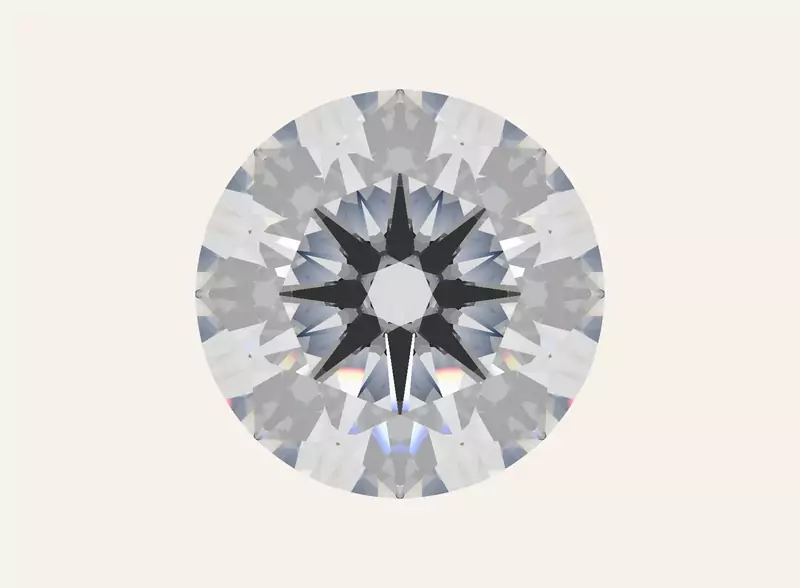
One round of about 1 ct, with a pavilion angle of 40.8 degrees and a total depth of 61.9%, modeled twice: in the studio light the other guides use, and in ASET light. In this model each point of the stone takes the color of the band most of its light comes from.
 Drag to turn
 Drag to turn
Drag either stone; both turn together.
Modeled illustrations from one stone's measurements, not listings.
What should a good round show in ASET?
GIA describes a diamond with the AGS Ideal 0 light performance grade as one that "remains bright from edge to center" while keeping light leakage low, with an "equal amount of contrast scattered across the entire stone." GIA also says the ASET Map shows a stone's optical symmetry, physical symmetry and optical efficiency.
The ASET patent gives examples of grades read from the map: more red gives a higher brightness grade, blue over roughly 10% to 40% of the map gives a high contrast grade, and less leakage gives a higher leakage grade. It adds that the cutoffs can vary with the cut and weight of the stone.
In this model, the well-cut round shows red over about two thirds of its face, blue over about a fifth, green over about a tenth, and almost no gray. Its blue sits inside the patent's example range of 10% to 40%.
What do a shallow and a deep round look like in ASET?
The pictures below are our models' results, not photographs of real stones: our sources do not show what a shallow or a deep pavilion looks like in a real ASET image. GIA's researchers describe how such stones look to the eye: a pavilion cut too shallow can give a fish-eye, and one cut too deep a dark center. Each pair is one round modeled twice, with only the pavilion angle changed.
Drag to turn Drag to turn
In this model, about a seventh of the shallow round's face shows gray, against almost none in the good round, and much of it sits in a ring just inside the table, where the fish-eye guide shows its ring of reflected girdle.
Drag to turn Drag to turn
In this model, most of the middle of the deep round's table turns blue, the band of light from nearly straight above, and green covers most of the stone outside the table. The dark center guide shows the same deep round in normal light, with its dark middle.
Drag either stone; both turn together.
Modeled illustrations from one stone's measurements, not listings.
What does a bow-tie look like in ASET?
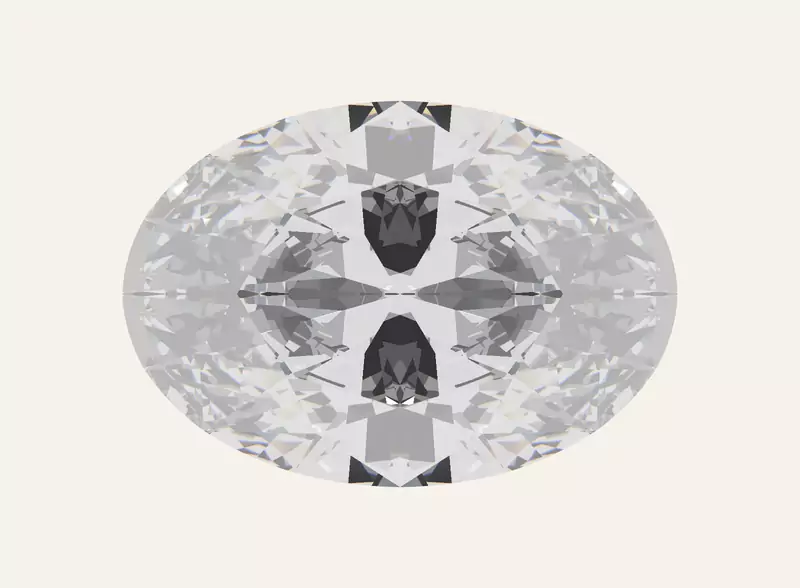
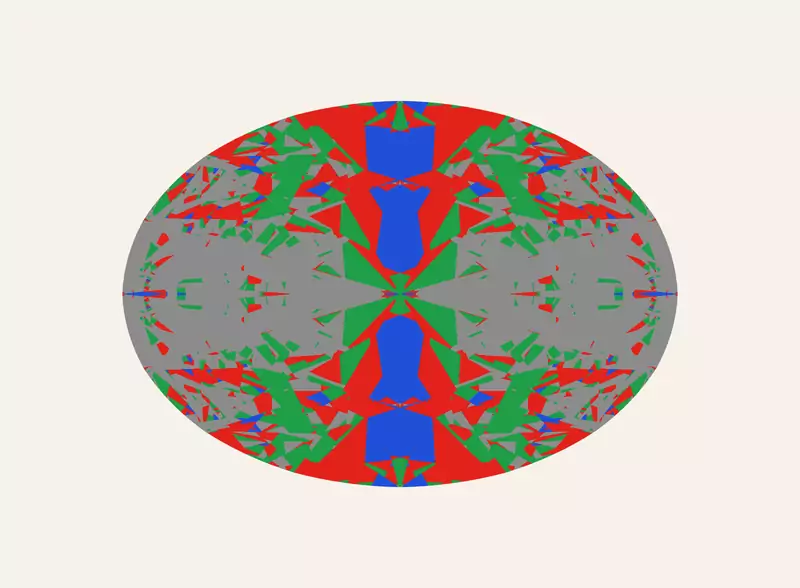
GIA describes a bow-tie as light "obscured by the observer (from high angles)" that "is channeled into the center" of the stone. In ASET colors, light from high angles is blue. Here is the clear bow-tie oval from our bow-tie guide, in normal light and in ASET light.
 Drag to turn
 Drag to turn
In this model the band shows blue, which fits GIA's description of a bow-tie: about two fifths of the middle strip is blue, against under a twentieth of the rest of the face. We have no source for how a bow-tie looks in real ASET images. The ends of this oval show gray, light from below the table plane: the model keeps one pavilion depth all round, so its pavilion slopes more gently toward the ends than across the width.
Drag either stone; both turn together.
Modeled illustrations from one stone's measurements, not listings.
What is an Ideal Scope, and how does it differ from ASET?
The Ideal Scope is an older, simpler viewer. GIA traces it to the FireScope of 1984; a portable Ideal-Scope came out in 2001. It uses a red reflector, and its picture has three colors:
- Black, 75 to 90 degreesReflections of the viewer's head and shoulders.
- Red, 0 to 75 degreesBright light the stone returns well.
- White, below 0 degreesLeakage: light that escapes through the pavilion instead of returning to the eye.
Our Ideal Scope light is a model of that picture: white for light from below the table plane, red from the table plane up to 75 degrees, and black from 75 degrees up. No source we use gives the angle where the black zone starts, so 75 degrees is our choice, the same edge as the ASET blue band. In this model the Ideal Scope has no green band.
 Drag to turn
 Drag to turn
In this model the good round shows red with black arrows and almost no white, and the shallow round shows white over about a seventh of its face, much of it in that ring. The black areas fall where the ASET pictures above show blue, because both start at 75 degrees in our models.
Drag either stone; both turn together.
Modeled illustrations from one stone's measurements, not listings.
How do I read a seller's ASET photo?
If a seller's ASET image is a photograph through a physical viewer, its leakage depends on the light behind the stone. The patent describes leakage that shows black when the light from behind is blocked, and white when light comes from behind, as with a viewer that uses room light. A white or black area in such a photo may be leakage.
An ASET Map from GIA is computed by software (GIA). It is an optional part of the AGS Ideal Report, a digital report GIA offers for eligible D-to-Z diamonds, natural and laboratory-grown (GIA). GIA announced the AGS Ideal Report as a US$25 digital supplement to its diamond reports, from January 2023 (GIA).
AGS Laboratories closed at the end of 2022, and its research and technology passed to GIA (GIA; American Gem Society).
What does an ASET image not tell you?
- How the stone looks when it moves. GIA notes that ASET looks at the stone still and face up, and that it does not model the real positions of a viewer's head and neck.
- How much light leaves through the crown. GIA's researchers write of colored dome viewers, the family ASET belongs to, that the method "does not measure the amount of light exiting the diamond's crown."
- The light of a real room. Its bands are a simplification of the lighting a diamond meets, as its developers say.
- The symmetry grade. GIA says a diamond can receive an Excellent symmetry grade but not an AGS Ideal 0 light performance grade, and that painting and digging out "may not affect the symmetry grade, but it can affect the light performance."
Sources
- Optical Engineering (2007), 46(9), 093604: Evaluation of brilliance, fire, and scintillation in round brilliant gemstones (Sasián et al.)
- US Patent 7,580,118 B2: Methods, apparatus, and systems for evaluating gemstones
- GIA: What is the ASET® Map on an AGS Ideal® Report?
- GIA, The Jewelry Symposium (2026): The Transformation of Diamond Cut Quality Grading: Where Are We Now? (Gilbertson and Reinitz)
- GIA: GIA Researchers Evaluate ‘Light Performance’ and Diamond Cut
- GIA: AGS Ideal® Report by GIA
- GIA: AGS and GIA Advance Their Common Missions
- American Gem Society: American Gem Society Laboratories Resource Page